Tuesday, January 26, 2016

Is Campus On A Low Sodium Diet?

Treated salt is identified by it's blue-ish hue
Kinda!

Our campus is nestled on the banks of the Thames River among the naturalized canopy of the Sherwood Fox Arboretum. Our buildings and associated infrastructure are steeped in heritage and date back nearly a century. As stewards of these gems, Facilities Management is constantly seeking better ways to protect Western's built and natural assets.

But this amazing historical landscape isn't our only priority. In fact, we have a greater commitment to the protection and safety of the people who visit, study, research, and work on our campus everyday.

And there is the dilemma - stuck between the rock (salt) and a hard place.

Now-retired manager of Landscape Services used to cringe when talking about the salt needed to protect pedestrians and motorists on campus, often - if not always - referring to it as 'the necessary evil'. And that's exactly what it is. It is the most effective way to keep roads, lots, and walkways clear during freezing and thawing cycles. However, wet rock salt, aka brine, is an aggressive composition with corrosive traits that can stress localized plant life. It is also destructive to metals and concrete, wreaking havoc on our vehicles and our buildings.

We have put the alternatives to the test.

Sand and ash have been ineffective, even after several applications - and - these methods create a new problem. The melting snow and sand/ash mixture spreads throughout buildings as foot traffic picks it up and brings it in through the entrances. The result is a never ending mess for our caretakers in Building Services. Salt stains are bad enough, adding dirt only makes it worse.

Liquid brine applications are used as a preventative measure to reduce ice binding with asphalt and concrete. The mixture requires completely dry surfaces and must be sprayed shortly before a snowfall or risk being washed away. The limitations make the procedure unreliable, time consuming, and wasteful.

Miracle ice melters? There are several brands of products that will melt ice and claim to be better than rock salt. However, they are essentially similar in composition and, because sold in smaller quantities, tend to be significantly more expensive than bulk purchases of rock salt.

Initiatives to reduce salt.

Facilities Management crews continue to distribute treated salt. Sodium chloride mixed with magnesium chloride improves ice-melting effectiveness at lower temperatures, requiring lighter applications.

Crews are certified in and continue to follow Smart About Salt training. Smart About Salt is a recognized body that provides awareness and guidelines for reducing road salt application for large institutions and municipalities. The program has influenced hand-salting procedures and has led to calibration of our salting machinery.

This year, Facilities Management crews are focussing on mechanical snow and ice removal. More crews are being deployed with shovels and plows to lift the snow/ice and salt is be used sparingly as a final measure. Dangerous areas that collect moisture and/or typically freeze over will continue to be salted - again, fulfilling our commitment to the campus community.

Western student paper, The Gazette features FMs salt use on campus; http://www.westerngazette.ca/life/why-you-so-salty-western/article_15dd33b0-bbe5-11e5-89d5-b72048cf6c39.html

FM announces use of treated salt in Western News (p.7); http://news.westernu.ca/wp-content/uploads/sites/2/2014/11/WNews-Feb14-08.pdf

FMs Salt reduction featured on Western's Sustainability website; http://www.uwo.ca/fm/initiatives/sustainability.html#salt

To report an icy spot or trouble area, please contact Facilities Management's Client Services at fmhelp@uwo.ca or 519-661-3304.

Tuesday, January 5, 2016

When It Arrives ... We'll Be Here

University College [Communications & Public Affairs]
From the book of obvious statements; It has been a mild winter.

Undoubtedly, that means the worst is yet to come. Infact, we will likely be on the verge of cold, blustery weather in the coming weeks - if not days.

Last year at this time, London was buried, digging out of the white stuff at a rate of 20cm every 12 hours. Crews were working in shifts around the clock on campus. As an archive of the event, the following page was maintained to keep the campus informed of Facilities Management's efforts; http://uwo.ca/fm/who/news/snow01072015.html

Should the weather turn south - er, well - north, Facilities Management is on snow removal standby. During a typical snowfall, crews will begin to clear snow in the evening when parking lots and sidewalks are less congested. If accumulation isn't excessive, the snow and ice will be cleared, sanded and salted prior to 8am with maintenance checks operating throughout the day.

If a major winter storm arrives, Facilities Management will follow the strategic Snow Operations Procedure. The Division's high level of preparedness has evolved as a result of battling snow over the decades, but the most valuable lesson remains that weather is a tough beast to tame. There are several variables that can take standard protocol off track. Factors such as, the time of day and duration the snow falls, the total volume of snow, wind and temperature (freezing or thawing) and even campus specific factors, such as the time of year (exams) or the day of the week (fridays can be quieter on campus). All these factors are balanced on the fly and they change constantly, requiring the Snow Operation Procedure to remain flexible - and that's putting it mildly.

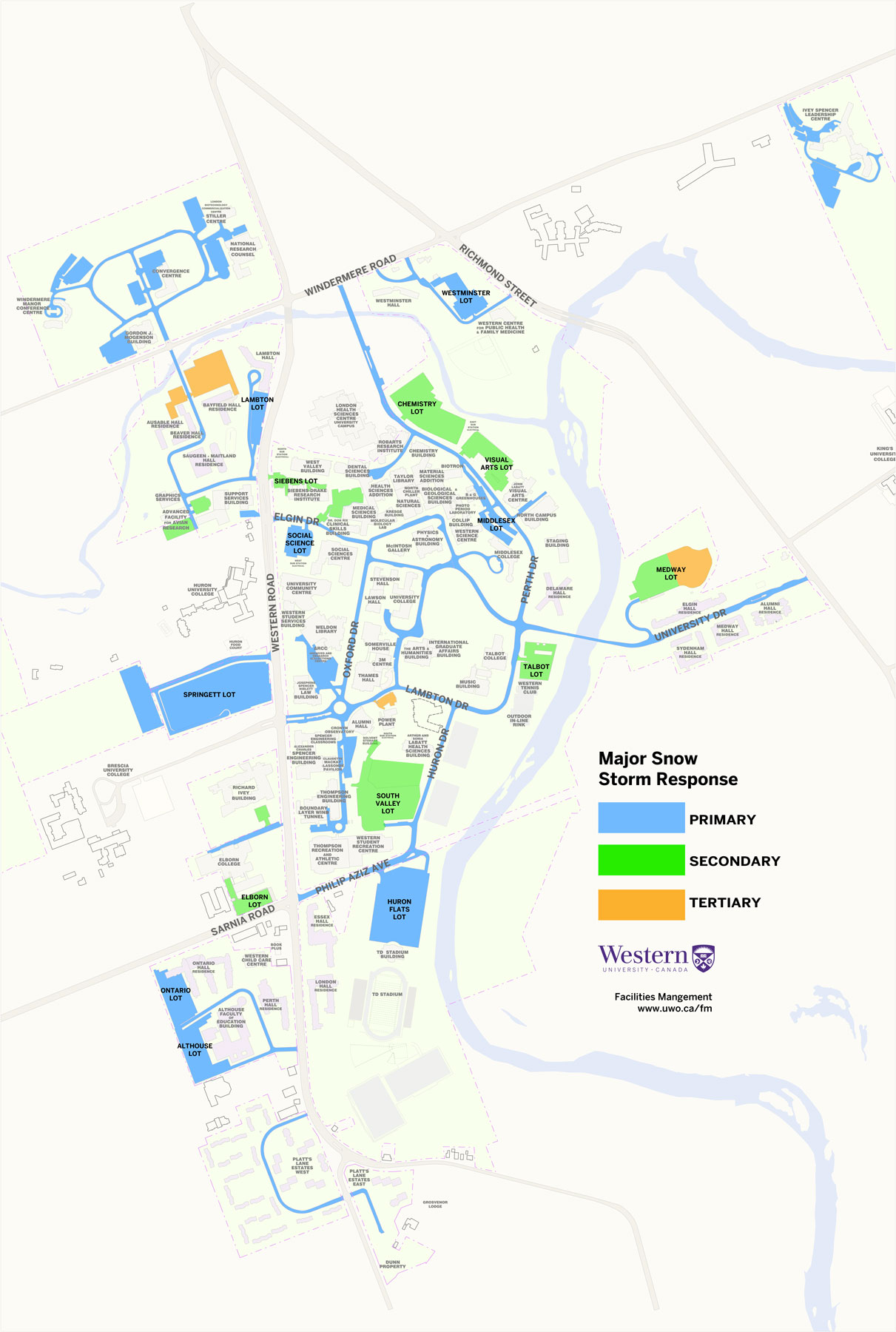
As a starting point the crews will follow the priority locations map and priority unit chart, especially when snow is falling faster than it can be cleared. In some cases, this can mean redoing portions of a higher traffic, higher priority location prior to moving on to other locations.

Priority Locations Map, based on safety, provision of essential services, and greatest impact.

Priority Unit Chart, listing most of the cleared surfaces on campus, complementing the map.

The top priority is the safety of our community. Facilities Management encourages people to take time and care when crossing campus and don't hesitate to connect with Client Services if weather is restricting our services. We will do what we can to help; fmhelp@uwo.ca or 519-661-3304.

Wednesday, December 9, 2015

Managing Energy Demand (or How Western Saves a Million Bucks)

Members of FM represented WesternU as
panelists at the COU Innovative Ideas Forum
Last week, Western sent three project teams to the COU Innovative Ideas Forum in Toronto as panelists; Procurement, Campus Police, and Facilities Management.

Facilities Management's team, Mary Quintana (Energy & Environment Specialist), Dan Larkin (WES Controls Systems Specialist), and Doug Johnson (Manager, Electrical Services/Controls) demonstrated the power of our homegrown utility dashboard and building automation system.

The dashboard project has driven a large-scale upgrade to steam, water and electrical meters. Each meter is a trackable distribution point, providing usage data that is displayed in real-time on the Utility Dashboard.

Along with our enhanced building automation system (Western Environmental Systems (WES) Controls), Western has the ability to interact with thousands of data points across the campus. WES uses occupancy sensors, thermostat set points and, in some cases, window sensors, to automatically adjust indoor climates and lighting to meet the needs of our campus community.

With these systems in place we can automate building systems to perform at optimal efficiency. These systems have allowed our team to manage electrical demand during peak load times, saving the University upwards of $1M annually.

• Western's Utility Dashboard is available to the public. We believe sharing our data and being transparent in our usage will help the campus community become more engaged, taking ownership for their part in resource management.

• Please take a minute (seven to be exact) to view FM's video presentation to Ontario's Ministers and higher learning institution leaders at the Innovative Ideas Forum; https://youtu.be/elS7k4GLbd8

• Our demand management strategy was recognized with the 2013 CAUBO Quality and Productivity Award

• For more information on the COU Innovative Forum, view the report; Faster, Cheaper, Smarter: Improving Efficiency at Ontario Universities. FM initiatives are featured on page 17.

Posted by Brandon Watson

Tuesday, March 27, 2012

Western Parking Survey - Win an iPad 3

As part of developing a comprehensive parking and transportation strategy for campus, Western Parking is conducting an online parking survey to determine current commuting patterns. The data collected from this survey will help identify and support future transportation strategies.

This survey will be conducted from March 21 - April 5, 2012 and will take participants about five minutes to complete.

Please visit (https://www.surveymonkey.com/s/WesternUniversityTravelSurve) to access the survey. After filling out the survey campus community members are invited to enter in a draw for an iPad 3. To enter the draw surveys must be completed, with a valid Western email account, by midnight April 5, 2012.

Related articles:

Western News
http://communications.uwo.ca/western_news/stories/2012/February/parking_study_to_help_drive_campus_plan.html

Wednesday, July 27, 2011

Re-purposed Battery Bits

The battery afterlife is right here in Ontario.

Raw Materials Company's (RMC) large decommissioning/processing plant takes Western's batteries and re-purposes their parts.

Recovered zinc and manganese is granulated and used in fertilizer. In this picture, the paper and plastics are separated and used for generating energy. The metal casings are removed and crushed for recycling.

Battery collection spots are now located all over campus. Have a look for them near the Green Board on your floor or recycling depot and fill 'em up.

For more info, contact Brandon Watson (bwatso5@uwo.ca), Facilities Management (formerly Physical Plant)

Wednesday, May 25, 2011

Take a self-guided tour of the nation's most beautiful campus

Whoa, it's been awhile since our last post. Well, hopefully the following will make the wait worthwhile. After careful planning and delicate refining, the 2011 Western Walking Tour map and guide is available.

Western is undoubtedly the nation's most attractive campus and now visitors can enjoy some its lesser known features with the recently released self-guided Walking Tour. The guide cuts a leisurely path through campus that includes green attractions, such as, the many gardens and naturalized areas, LEED buildings, and relevant green research locales. The guide also brings light to some of the history that makes Western so aesthetically unique.

Hard copies will be available from Physical Plant upon request (bwatso5@uwo.ca) - the online version is available for download now [PDF].

The tour was created through a partnership between members of the Geography Department, Graphic Services, and Physical Plant Division.
Enjoy!

Wednesday, February 2, 2011

Snow no match for our grounds crew

It wasn't quite the storm that we were expecting, but it was still enough to put all-hands-on-deck in Physical Plant's grounds department. They worked overnight to make short work of the recent snow fall.

All eight full-time staff and four part-timers were in early to get the roads/sidewalks cleared as the wind and snow whipped through SW Ontario on the morning of February 2. Using their arsenal of equipment, the team aims to have the campus uncovered by 6am - that usually means their shift will begin at midnight. Some of the larger lots (such as Althouse and Springett) and stairways are contracted to ease the massive undertaking.

Western has roughly 17km of roadway, even more distance in sidewalk, and about 7,000 parking lots that need to be plowed and de-iced.